
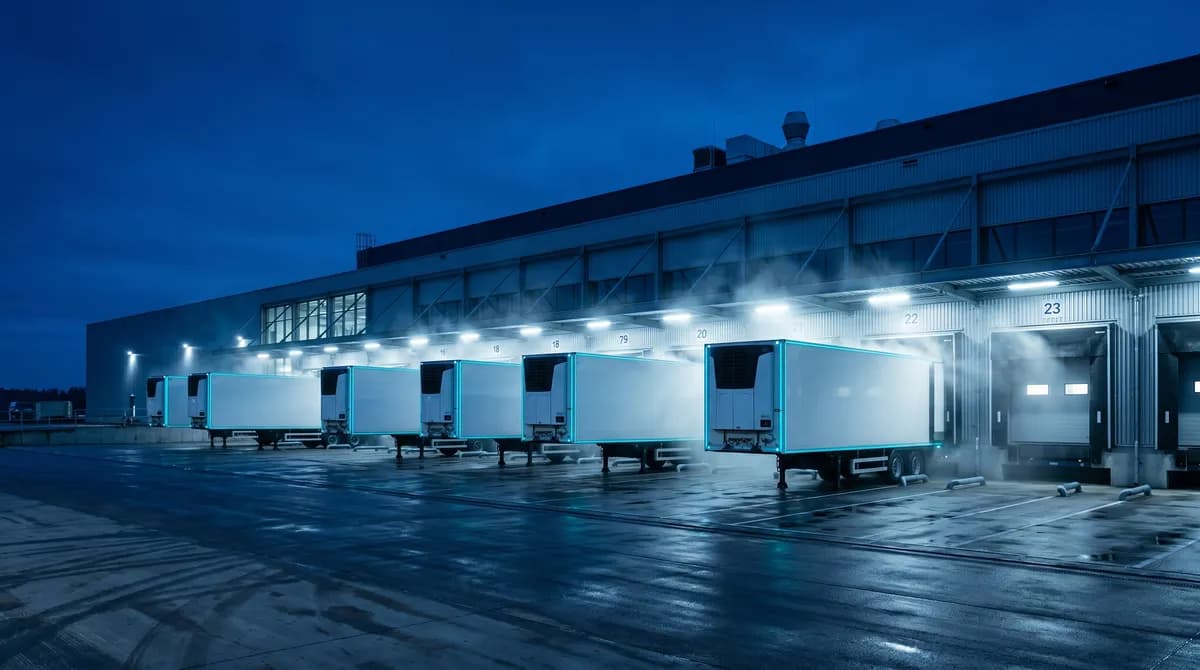
Dock-door dwell time is one of those operating metrics that almost nobody measures and everybody pays for. A trailer pulled to the door, seal broken, door open for 18 minutes while the dock crew finds paperwork, plus another 12 minutes of intermittent open-close while pallets roll in. Thirty minutes of warm air pulling into a frozen room on a 33 degrees C day in May.
The cost shows up on the electricity bill, on the product quality side, on the equipment wear-and-tear side, and on the staff comfort side. We have run the numbers across our network for the past two years, and the math is meaningful.
What the data says
At the Mehsana facility, dock-door dwell averages 14 minutes per inbound trailer in cooler months and 22 minutes per inbound trailer in May. The summer number is the one to watch. Each 60 seconds of open dock door on a hot day pulls roughly 0.7 kW-hours of additional refrigeration load into the room, depending on the size of the doorway and the temperature differential.
Across a facility doing 60 inbound trailers a day in May, that is about 14,000 extra kW-hours per month attributable to dock-door dwell. At Gujarat HT industrial rates that is around 110,000 rupees a month. Across a year, with seasonal variation, it lands at 700,000 to 950,000 rupees per facility per year. Not catastrophic on its own, but real.
Where the cost is bigger than electricity
The bigger cost is product quality. Pallets staged near the dock door warm up during long door cycles. Refrigerated pallets near the door can drift 2 to 3 degrees C above setpoint during a 20-minute door cycle. Frozen pallets drift less but not none.
A grocery customer that audits a sample of inbound product temperatures will see those door-side pallets above spec, and the debit note comes through. The 14,000 kW-hours per month is the small problem. The debit note is the bigger one.
The other hidden cost is air-curtain wear. Dock-door air curtains (the high-velocity air streams that minimise air exchange) run hot when the door is open. Frequent long cycles wear them out faster, and replacement runs into lakhs of rupees per door.
How to fix it
Three operational changes pay back the most.
First, reduce dwell at the seal. Most dock-door dwell is paperwork, not pallet handling. Move paperwork off the dock floor and onto the WMS so the seal break is the start of pallet movement, not the start of paperwork chasing. Pre-stage receiver labels and dock-door assignments in the WMS before the trailer arrives.
Second, sequence dock-door assignments to keep adjacent doors closed. If doors 12 and 13 are open at the same time on a hot day, the air movement compounds. Sequencing inbound trailers so adjacent doors are not open simultaneously reduces the compound effect.
Third, run dock-door air curtains on every receiving operation, every season. Some operators run air curtains only in summer because they are loud. They are also the single biggest factor in limiting air exchange during a dock cycle. Run them year-round, replace them on a schedule, and inspect them quarterly.
How to measure it
If you are not measuring dock-door dwell, start with a 30-day baseline. Most modern dock-door systems can log door state via reed switches feeding into the WMS or a dedicated dock-management system. If the existing system does not log it, retrofit costs are modest (typically a few thousand rupees per door for a basic logger).
Once the baseline is in hand, set a target of 8 to 12 minutes per inbound trailer in cooler months, 12 to 16 minutes in May. These are achievable numbers. Most operators come in 50 to 80 percent higher than this without realising they have a problem.
What we did
We started measuring dock-door dwell at the Mehsana facility from commissioning. The baseline came in at 18 minutes (cool season) to 27 minutes (May). After operational changes (paperwork moved off the dock, sequenced door assignments, air-curtain replacement schedule tightened) we are at 14 (cool season) and 22 (May). Facility electricity bill is down meaningfully as a result. Debit note rate on inbound temperature audits is down 40 percent.
The bigger result is staff comfort. Dock crews working in front of a wide-open door in May or June are not happy crews. The shorter the dwell, the better the working environment, and the easier it is to retain dock staff.
A simple rule
If your operations team cannot tell you the average dock-door dwell on inbound trailers, you have an unmeasured operating cost. Start measuring it. Set a target. Track it monthly. The math will surprise you in the direction of savings.