
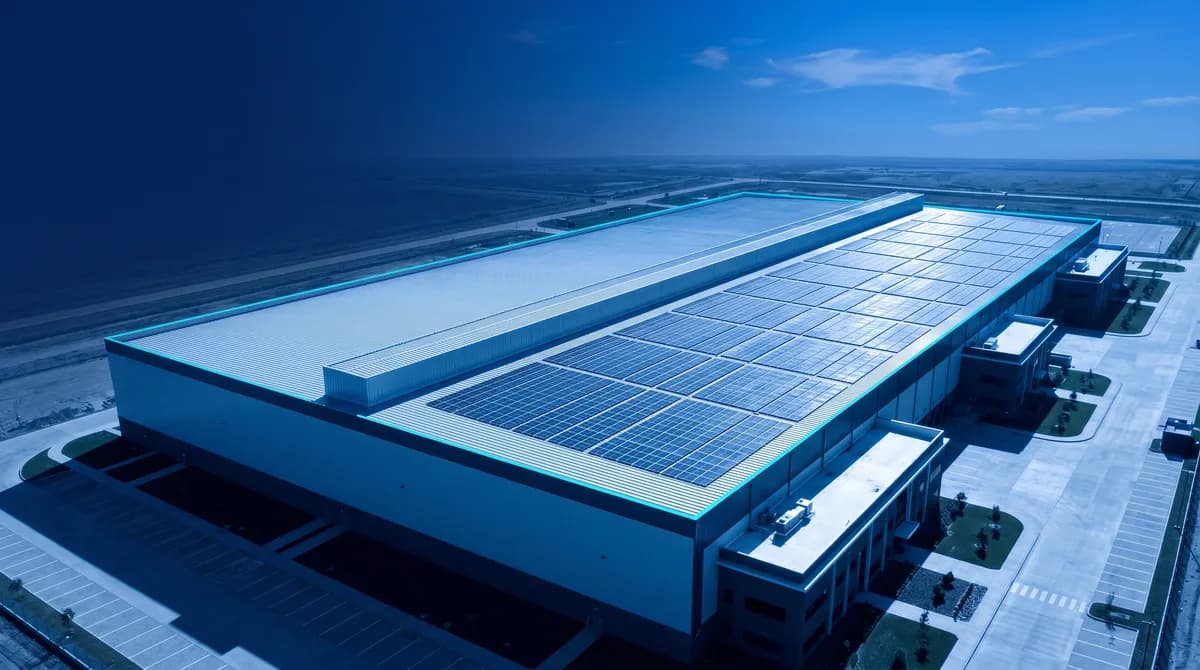
Cold storage uses a lot of energy. We are honest about it.
Industrial solar offset on the refrigeration grid, rainwater harvesting on site water, single-setpoint operation across three chambers, and a clear path toward Net Zero Carbon at the Mehsana facility.
Six places we work, six numbers we publish.
Industrial solar
The Mehsana site runs an industrial solar generation programme that offsets the heavy refrigeration grid load with clean energy. The intent is to push as much of the chamber duty as practically possible onto solar electrons during the day, and to publish the offset percentage every year so customers can plan their own Scope 3 reporting against a real number rather than an estimate.
Industrial solar offset on chamber duty
Single-setpoint efficiency
Most Indian cold rooms cycle between chiller and freezer temperatures, which costs energy and shortens compressor life. The Mehsana plant runs three independent chambers, all at a single precision frozen setpoint of -18 degrees C. The compressors never see a warm cycle. The plant runs leaner because the duty does not move.
One setpoint, three chambers, no cycled rooms
Rainwater harvesting
Rainwater harvesting infrastructure is built into the site, sized for both internal reuse and localised groundwater replenishment. The Gujarat monsoon is short and concentrated, so the catchment design has to do more work in fewer weeks. The water that lands on the roof and apron goes back to the ground or back to the wash bay, not into the drain.
Rainwater harvesting across roof and apron
Reefer yard charging
The 50+ truck reefer yard has active charging points on the bays. Trailers can wait sealed with the gen-set off, which removes the idling diesel emissions that most yards still tolerate. The grid electron that holds the trailer cold is dramatically cleaner than the diesel one.
Active charging on the reefer yard
Movable rack volumetric efficiency
The movable rack high-density storage system stores more pallets in the same conditioned volume, which means less refrigerated cubic metres per pallet held. Lower volumetric overhead is the cleanest sustainability gain a cold operator can engineer at the design stage.
High-density rack, less conditioned volume per pallet
Path to Net Zero
Net Zero Carbon is the long-arc operating ambition for the Mehsana facility. The current programme is industrial solar plus rainwater plus active yard charging plus single-setpoint plant design. The next steps are battery storage for compressor ride-through and a structured PPA on the residual grid load. We will publish progress when we have numbers we can stand behind.
Working toward Net Zero Carbon at Mehsana
What we are publishing against.
- 2026
Commission three-chamber single-setpoint plant with industrial solar offset and rainwater harvesting at Mehsana.
- 2027
Publish first annual sustainability disclosure with audited solar offset and water reuse data.
- 2028
Add battery storage sized for compressor ride-through during grid events at the Mehsana site.
- 2030
Reduce Scope 1 and 2 emissions per pallet against the 2026 baseline at a publishable rate.
- 2035
Reach Net Zero Carbon ambition on Scope 1 and 2 at the Mehsana facility.
Three pieces of the operating model.
Mehsana (single setpoint)
Three chambers, one precision frozen setpoint, no cycled rooms.
The plant was sized for one job at -18 degrees C across all three chambers. No cycled chiller, no glycol loop for a part-time refrigerated room. The compressors run leaner because they never see a warm cycle, and the chambers can be operated as one duty or split across three brands without changing the energy profile.
Mehsana (industrial solar)
Solar offset programme on the refrigeration grid load.
Gujarat irradiance suits rooftop and ground-mount solar across the calendar. The Mehsana site offsets a meaningful share of the chamber duty with clean electrons during the day, and the residual grid load is the engineering target for the next phase of the programme.
Mehsana (rainwater harvesting)
Roof and apron catchment for site water reuse and groundwater recharge.
The rainwater harvesting build sizes the roof and apron catchment to the short Gujarat monsoon. Water goes to wash bay reuse, to the cooling loop, and to localised groundwater recharge through the site soak pits. The drain is the last option, not the first.
Want the methodology?
Our sustainability disclosure carries the methodology behind the solar offset, water reuse, and energy numbers. Ask for the document or scope a call with our sustainability lead.